


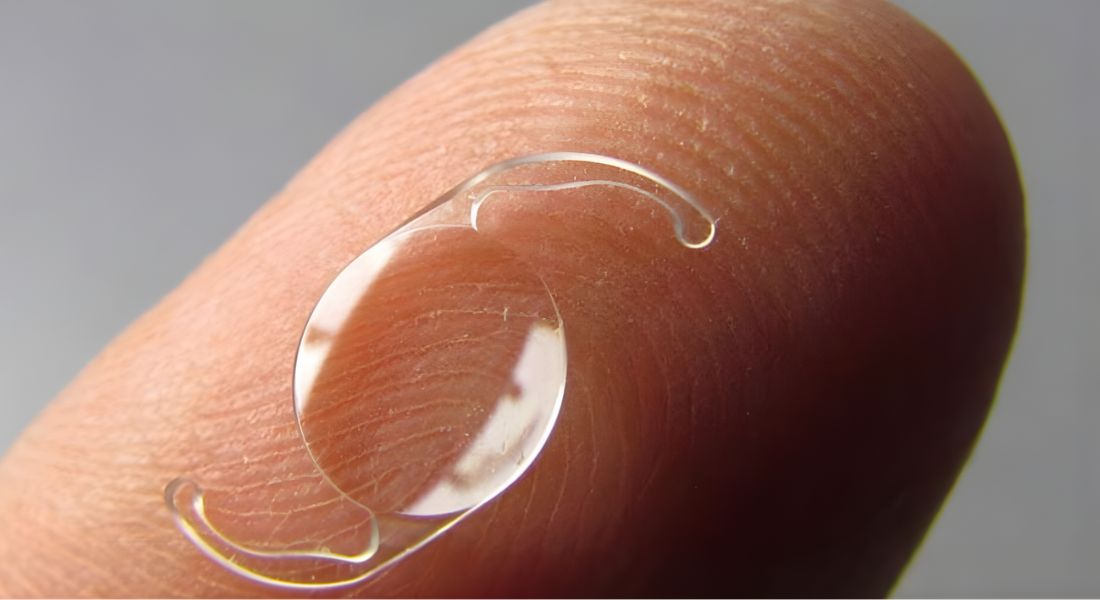
When patients ask about lens replacement, one of the first questions I hear is about the difference between standard and premium intraocular lenses (IOLs). Most people understand cataract surgery or lens exchange in general terms but are unsure how lens technology has evolved. Premium IOLs go beyond simple vision correction, offering options that can reduce dependence on glasses and improve vision at multiple distances.
What defines a premium IOL is its design and functionality. Some lenses provide multifocal or extended depth of focus, allowing clearer near, intermediate, and distance vision. Others correct astigmatism with toric designs, or reduce visual aberrations with aspheric optics. These features aim to deliver more natural and higher-quality vision compared with standard monofocal lenses.
Whether a premium lens is worth it depends on individual factors. Lifestyle, visual expectations, and eye anatomy all influence whether the benefits justify the investment. For some patients, the reduced need for glasses and enhanced visual quality is transformative, while for others, a standard lens meets their needs perfectly.
In my practice, I guide each patient through a personalised assessment, considering ocular measurements, visual goals, and daily activities. This ensures that the lens chosen aligns with their lifestyle and provides the best possible long-term satisfaction.
What Makes an IOL “Premium”?
Not all lenses are created equal, and the distinction between standard and premium IOLs is more than just marketing. While a basic lens restores distance vision after cataract surgery, premium options are engineered to tackle multiple visual challenges at once. They are designed for patients who want more independence from glasses and sharper visual performance across different distances. Understanding the specific benefits of premium lenses helps set realistic expectations and guides optimal lens choice.
- Multifocal Capability: Premium multifocal lenses provide clear vision at near, intermediate, and distance ranges. This allows patients to perform everyday tasks like reading, computer work, and driving without constantly switching spectacles. In practice, this can significantly improve quality of life for those who value visual freedom.
- Astigmatism Correction (Toric Lenses): Toric premium lenses are tailored to correct corneal astigmatism, reducing or eliminating the need for cylindrical prescriptions. Proper alignment during surgery is crucial, as even slight rotation can compromise visual outcomes. When executed correctly, these lenses allow patients to enjoy sharper, more focused vision across all distances.
- Extended Depth-of-Focus (EDOF) Technology: EDOF lenses provide a continuous range of focus, bridging the gap between near and distance vision without major compromises in contrast sensitivity. This makes tasks like reading a phone or viewing a computer screen much easier. Patients often report more natural visual transitions and less dependence on reading glasses.
- Addressing Multiple Visual Needs: What separates premium lenses from standard monofocals is their ability to manage more than just distance vision. Patients who choose premium IOLs often seek reduced reliance on spectacles across multiple visual ranges. By addressing several visual challenges simultaneously, premium lenses offer a more comprehensive and satisfying postoperative experience.
The real advantage of premium IOLs lies in the combination of technologies rather than a single feature. When chosen and implanted correctly, they transform patient outcomes from merely functional to highly independent. This makes them a compelling choice for anyone prioritising long-term visual freedom and convenience.
Multifocal IOLs: Seeing Clearly at All Distances
Multifocal IOLs use concentric optical zones to focus light at different distances, allowing patients to see clearly for reading, computer work, and driving without relying on glasses. This design provides a practical solution for those who want independence from spectacles in daily life.
I always explain to patients that adaptation is part of the process. Some individuals notice halos or glare initially, especially in low-light conditions, as the brain learns to interpret multiple focal points. This adjustment period is usually temporary and lessens over time.
The main benefit of multifocal lenses is their versatility. For patients who prioritise convenience and freedom from glasses, these lenses can transform everyday activities, providing functional vision across near, intermediate, and distance tasks with minimal compromise.
Toric IOLs: Tackling Astigmatism
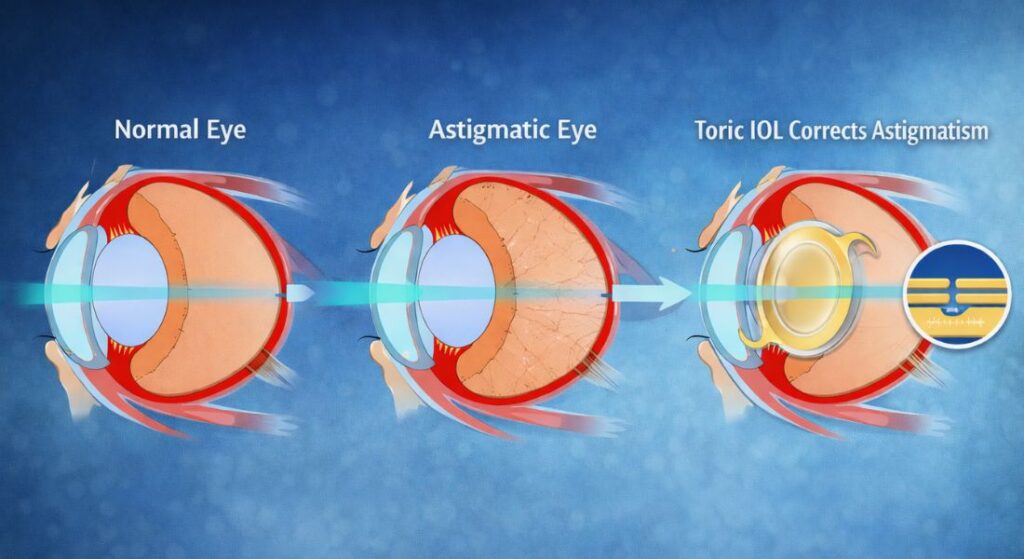
Astigmatism occurs when the cornea’s curvature is irregular, causing blurred or distorted vision that cannot be fully corrected with standard lenses. Toric IOL are premium lenses designed to specifically correct this condition, with differing curvatures along precise axes to counteract the corneal irregularity and restore sharp focus.
The key to their success lies in exact alignment. Even a minor rotation after implantation can significantly reduce the corrective effect, which is why I emphasise careful pre-operative measurements, accurate axis marking, and meticulous surgical technique. In some cases, intraoperative guidance systems are used to ensure the lens sits perfectly on the intended axis.
For patients with moderate to high astigmatism, toric IOLs can transform vision. Many achieve excellent uncorrected distance vision and experience minimal dependence on glasses. The improvement isn’t just about clarity; it enhances comfort and visual confidence for daily activities, including driving, reading, and computer work.
Extended Depth-of-Focus Lenses: The Best of Both Worlds?
Extended depth-of-focus (EDOF) lenses are a newer type of premium IOL designed to provide a smooth, continuous range of focus. Unlike traditional multifocal lenses, they do not split light into multiple focal points, which helps reduce the risk of halos, glare, and other night-time visual disturbances.
I usually recommend EDOF lenses for patients seeking a balance between distance and intermediate vision, with some functional near vision. They are particularly useful for those whose daily routines combine office or computer work with outdoor or recreational activities, offering clear, comfortable vision across multiple tasks.
The advantage of EDOF lenses is that they provide functional vision without the trade-offs often associated with multifocals. While reading up close may still require occasional glasses, most patients find that their dependence on spectacles is greatly reduced, making daily life more convenient and visually comfortable.
How Premium IOLs Differ from Standard Lenses
The main difference between standard and premium IOLs lies in the range and quality of vision they provide. Standard monofocal lenses restore distance vision reliably but usually leave patients needing reading glasses for near tasks. Premium IOLs, on the other hand, expand the visual range and, in the case of toric lenses, also correct corneal irregularities like astigmatism.
It’s important to recognise that “premium” does not mean perfect. Some patients may notice mild optical side effects such as halos, glare, or slight contrast reduction, particularly in the early weeks after surgery. In most cases, the brain adapts over time, and these effects become less noticeable.
The ultimate aim with premium lenses is to maximise independence from glasses while maintaining high-quality, functional vision. Careful lens selection, precise surgical technique, and realistic patient expectations all play a role in achieving a successful outcome.
Who Benefits Most from Premium IOLs
Premium lenses are not a one-size-fits-all solution, and choosing the right candidate is critical to achieving satisfaction. The best outcomes come from matching the lens technology to a patient’s lifestyle, ocular health, and expectations. Overlooking these factors can lead to disappointment, even if the surgery itself is technically flawless. Careful preoperative assessment allows us to align lens capabilities with real-world visual demands.
- Lifestyle Needs: Patients who spend significant time on reading, computer work, or outdoor activities gain the most from premium lenses. These lenses reduce dependence on glasses across multiple distances, which directly improves day-to-day convenience. In practice, lifestyle mapping during consultation helps identify who will truly benefit.
- Ocular Health: Certain ocular conditions, such as corneal irregularities or macular degeneration, can interfere with the performance of multifocal optics. Patients with these issues may experience suboptimal vision or increased visual disturbances. Assessing ocular health beforehand ensures we avoid prescribing lenses that will not meet expectations.
- Patient Expectations: Managing expectations is critical, particularly regarding trade-offs like mild night-time halos or glare. Patients who understand potential compromises are more likely to be satisfied with their outcomes. Clear communication during consultation prevents surprises and builds realistic optimism.
- Age and Visual Demands: Younger patients or those with active lifestyles often derive the greatest functional benefit from premium features. Their daily activities demand a broad range of focus and visual independence. Matching lens selection to age and visual demands maximises the value patients experience over the long term.
Ultimately, premium IOLs succeed when the right lens meets the right patient. A tailored approach ensures that surgical excellence translates into meaningful improvements in quality of life. By carefully evaluating each patient’s eyes, habits, and expectations, we can deliver outcomes that are both technically precise and genuinely satisfying.
The Decision-Making Process I Follow
When guiding patients on premium IOLs, I follow a clear, structured approach to ensure choices match their eyes and lifestyle. First, I perform a comprehensive eye exam, including corneal mapping, macular assessment, and precise biometric measurements. These data points are critical for selecting the lens type that will function optimally in each individual eye.
Next, we discuss lifestyle and visual priorities. I want to understand how the patient uses their vision day to day whether they spend long hours at a computer, drive frequently at night, or do close-up hobbies so we can tailor recommendations to practical needs.
Education is key. I explain multifocal, toric, and EDOF lenses in simple, non-technical language, covering potential benefits and trade-offs. Where possible, we use lens simulations or trials to set realistic expectations. Finally, through shared decision-making, we select the lens that balances visual quality, independence from glasses, and minimises optical side effects. This process ensures patients are confident and satisfied with their outcomes.
Realistic Expectations for Premium IOLs

Premium IOLs offer remarkable improvements in vision, but it’s important to understand they are not a perfect substitute for the natural lens. Some patients may still need reading glasses for very fine print, and adjusting to multifocal optics can take several weeks as the brain adapts to processing multiple focal points simultaneously. Patience and consistent follow-up are key during this adaptation period.
I emphasise that success should be measured in terms of functional vision and independence from spectacles, rather than expecting flawless vision at every distance. Most patients notice a significant reduction in the need for glasses and report satisfaction with daily activities such as driving, reading, using digital devices, and engaging in hobbies that demand visual precision.
Setting realistic expectations also helps prevent post-operative frustration. Patients who understand the potential trade-offs like mild halos or slight contrast changes tend to be more confident in their lens choice and enjoy the full benefits of their premium IOL. When managed properly, these lenses provide consistently high-quality vision and greater freedom from corrective eyewear.
Advances in Lens Technology
Premium IOL technology has advanced rapidly over the past decade. Newer multifocal designs minimise halos and glare, toric lenses now offer improved rotational stability, and EDOF lenses deliver smoother transitions across distances, enhancing overall visual comfort.
These innovations give patients far more options than ever before, allowing me to tailor lens selection to their unique ocular anatomy and lifestyle. By matching the lens’s optical design to each patient’s visual priorities, I can optimise outcomes while reducing the likelihood of unwanted visual phenomena.
Ultimately, these advances make it possible to achieve high-quality vision across multiple distances with greater independence from glasses. Careful evaluation and personalised planning remain essential to harness the full benefits of modern premium lenses.
Cost Considerations
Premium IOLs come with an additional cost compared to standard monofocal lenses, and I always make sure patients understand this upfront. It’s important to weigh the expense against the benefits: reduced dependence on glasses, improved quality of life, and functional vision across near, intermediate, and distance tasks. For patients who value convenience and visual freedom, the long-term gains often justify the initial investment.
Many find that premium lenses significantly enhance daily life, from driving and computer work to reading and pursuing hobbies, without the constant need for spectacles. The sense of independence and comfort these lenses provide can be transformative, particularly for those with active lifestyles or demanding visual requirements.
That said, premium lenses are not necessary for everyone. Patients who primarily need clear distance vision or are comfortable using reading glasses for near tasks can achieve excellent outcomes with standard IOLs. Careful discussion of lifestyle, expectations, and financial considerations ensures each patient makes an informed choice that best suits their needs.
Integrating Premium IOLs with Cataract Surgery
For patients undergoing cataract surgery, premium IOLs offer the combined benefit of removing the clouded natural lens and providing advanced vision correction in a single procedure. This dual advantage allows many patients to significantly reduce or even eliminate dependence on spectacles, which is particularly valuable for those with active lifestyles, work demands, or hobbies requiring clear vision at multiple distances.
A detailed pre-operative assessment is critical to ensure the chosen lens aligns with the patient’s ocular anatomy and visual needs. I carefully evaluate corneal shape, pupil size, anterior chamber depth, and overall eye health to predict how the lens will perform post-operatively. This step ensures the lens provides optimal focus, comfort, and long-term stability.
Proper lens selection also minimises the risk of post-operative optical disturbances such as glare, halos, or reduced contrast sensitivity. By integrating premium IOL choice into cataract surgery with precise planning and personalised recommendations, I can deliver outcomes that offer both clarity and convenience. Patients often leave with high satisfaction, enjoying functional vision for reading, computer work, driving, and other daily activities without reliance on glasses.
Addressing Common Patient Concerns

Even when premium IOLs are technically successful, patients often enter surgery with understandable questions and worries. Concerns around glasses dependence, night vision, and safety are the most frequent. Addressing these openly and early prevents disappointment and aligns expectations with realistic outcomes. A structured discussion ensures patients feel informed and confident about their choices.
- Will I Still Need Glasses?: Most patients experience minimal reliance on spectacles after premium lens implantation, particularly for intermediate tasks such as computer work or cooking. Multifocal and EDOF lenses significantly reduce near and intermediate dependence, though occasional reading glasses may still be required for very fine print. Clear communication helps patients understand where minor limitations might remain.
- Night Vision Considerations: Some patients notice mild halos or glare during the initial months after surgery. These visual phenomena usually decrease as the brain adapts to the optics of the lens. Preparing patients for this adjustment period prevents unnecessary concern and supports smoother adaptation.
- Safety of Premium Lenses: Modern IOLs are highly biocompatible and are implanted using standard, well-established surgical techniques. Complications are uncommon when proper patient selection and surgical protocols are followed. Emphasising the robust safety record helps reassure patients who might be hesitant about “advanced” lens technology.
Open, honest conversations and realistic expectation management are what separate satisfied patients from those who leave uncertain. When patients understand both the benefits and minor limitations of premium lenses, they are far more likely to enjoy their enhanced vision with confidence. Clear communication and reassurance are as vital as surgical precision in delivering excellent outcomes.
My Approach to Patient Education
I always prioritise encouraging patients to ask questions and fully understand what to expect before surgery. We discuss lens design, potential optical phenomena, and functional benefits in detail so they can make well-informed decisions. The conversation goes beyond technical specifications it’s about how the lens will integrate into daily life, from reading and screen work to hobbies and driving.
I also provide practical resources and simulations whenever possible. These allow patients to experience the difference between standard and premium lenses in real-world scenarios, such as night driving, computer use, or close-up reading. Seeing these comparisons helps them appreciate how their choice will affect everyday activities.
By taking this hands-on, personalised approach, patients gain confidence and clarity about their options. They leave the consultation with realistic expectations, reduced anxiety, and a clear understanding of which lens will best suit their visual needs and lifestyle, setting the stage for high satisfaction after surgery.
Case Examples
One patient in their mid-50s had high astigmatism and an active lifestyle, so we chose a toric multifocal IOL. Post-operatively, they achieved excellent distance and near vision and could resume work, sports, and hobbies without relying on glasses. Their visual independence highlighted the benefit of matching lens type to lifestyle demands.
Another patient preferred an EDOF lens due to mild sensitivity to halos. This choice provided a continuous range of vision for everyday tasks, with minimal optical side effects, allowing them to read, drive, and use digital devices comfortably. The outcome demonstrated how careful lens selection based on patient priorities can optimise satisfaction.
These examples underline that premium IOLs deliver the best results when lens choice is personalised. By considering anatomy, visual needs, and lifestyle, I can ensure patients enjoy both high-quality vision and functional freedom.
Long-Term Outcomes
Clinical studies consistently demonstrate high patient satisfaction and functional independence with premium IOLs. Most patients achieve excellent distance and intermediate vision, allowing them to perform everyday tasks like driving, computer work, and hobbies without relying on spectacles. Near vision is also greatly improved, with many patients requiring reading glasses only occasionally, if at all.
Minor optical phenomena, such as halos or glare, can occur initially, but most patients adapt within a few weeks. Clear pre-operative counselling and personalised lens selection minimise these effects, and post-operative complications or dissatisfaction are uncommon when planning is meticulous. I emphasise that patience during the adaptation period is key to achieving the best functional results.
These outcomes underscore that premium IOLs can be a highly worthwhile investment for many patients. When combined with careful assessment of ocular anatomy, lifestyle needs, and visual priorities, premium lenses offer long-term clarity, reduced dependence on glasses, and a quality of vision that supports both professional and personal activities. Patients consistently report feeling liberated from visual limitations and highly satisfied with the results.
Integrating IOL Surgery in London Practices
For anyone considering lens replacement, choosing a surgeon experienced in premium IOLs is essential. Expertise in advanced biometric assessment, precise lens selection, and personalised surgical planning makes a significant difference in visual outcomes.
A careful pre-operative evaluation ensures the lens aligns with your ocular anatomy and lifestyle needs, reducing the risk of post-operative optical disturbances and maximising functional vision. I emphasise that successful premium IOL surgery is not just about the lens itself, but how it integrates with your eyes and daily activities.
If you’re exploring options, IOL Surgery in London offers comprehensive evaluation, tailored lens selection, and guidance throughout the process. This approach ensures patients leave with clear, comfortable vision and minimal dependence on glasses, while enjoying long-term satisfaction and visual freedom.
FAQs:
1. What makes an IOL “premium” compared with standard lenses?
Premium IOLs provide advanced features such as multifocal or extended depth-of-focus (EDOF) designs, toric correction for astigmatism, and aspheric optics to reduce aberrations. Standard monofocals only reliably restore distance vision and usually require reading glasses for near tasks.
2. Will I still need glasses after a premium IOL?
Most patients experience significantly reduced dependence on spectacles, particularly for distance and intermediate vision. Occasional reading glasses may be needed for very fine print, especially with EDOF lenses.
3. How long does it take to adapt to a premium IOL?
Adaptation varies, but most patients notice improvement within a few weeks. The brain gradually learns to interpret multiple focal points with multifocal lenses, while EDOF lenses typically require minimal adjustment.
4. Are premium IOLs suitable for all patients?
Not always. Success depends on ocular health, lifestyle needs, and realistic expectations. Patients with macular disease or significant corneal irregularities may not benefit fully from multifocal optics.
5. What are the risks or side effects of premium IOLs?
Some patients notice mild halos, glare, or slight contrast reduction initially. These effects usually diminish as the brain adapts, and careful lens selection minimises their impact.
6. How is lens selection personalised?
I use precise measurements including corneal mapping, macular assessment, anterior chamber depth, and lifestyle analysis. This ensures the lens matches the patient’s anatomy and visual priorities for optimal outcomes.
7. How important is surgical technique for premium IOLs?
Extremely important. Accurate alignment, especially for toric lenses, and meticulous implantation are crucial to achieving intended vision and minimising complications.
8. Can premium IOLs improve night vision?
They don’t enhance night vision, but modern designs minimise halos and glare compared with older multifocals. Patients are counselled about temporary night-time adaptation during the early post-operative period.
9. Are premium IOLs reversible?
Yes. The lens can be exchanged if necessary, although this is uncommon with correct pre-operative planning and implantation.
10. Are premium IOLs worth the extra cost?
For patients seeking independence from glasses and functional vision across multiple distances, the long-term benefits often outweigh the investment. Those primarily needing distance vision may achieve excellent outcomes with standard monofocals.
Final Thoughts: Choosing Vision That Fits Your Life
Premium IOLs are about more than just vision correction they’re about freedom, convenience, and confidence in your daily activities. When lens choice is personalised to your eye anatomy, lifestyle, and visual priorities, the results can be transformative, reducing reliance on glasses across multiple distances and enhancing overall quality of life. Success isn’t just about the technology; it’s about careful planning, precise surgery, and realistic expectations.
Adaptation is part of the journey, especially with multifocal lenses, but most patients find that within weeks, their visual experience becomes seamless. The key is clear communication and structured follow-up, which ensures any minor issues are managed early and effectively. With the right approach, premium IOLs offer consistent, high-quality vision for years to come, supporting both work and leisure activities with minimal compromise. If you’re looking for IOL surgery in London, you can get in touch with us at London Cataract Centre.
References:
- Zvorničanin, J. and Zvorničanin, E. (2018) ‘Premium intraocular lenses: the past, present and future’, Journal of Current Ophthalmology, https://pubmed.ncbi.nlm.nih.gov/30555960/
- Moshirfar, M., Stoakes, I.M., Theis, J.S., Porter, K.B., Santos, J.M., Martheswaran, T., Payne, C.J. and Hoopes, https://www.mdpi.com/2077-0383/12/13/4365
- Braga‑Mele, R., 2014. Multifocal and Toric Intraocular Lenses: Relative Indications and Outcomes. Asia Pacific Journal of Ophthalmology https://www.sciencedirect.com/science/article/abs/pii/S0886335013016313
- Badawy, M.M. and Ismail, Z.F., 2024. Comparison Between Intraocular Lenses TECNIS Eyhance IOL and AcrySof in Cataract Surgery Outcomes https://academic.oup.com/qjmed/article/117/Supplement_2/hcae175.631/7904120
- Cho, J.-Y. et al. (2022) Visual outcomes and optical quality of accommodative, multifocal, extended depth‑of‑focus, and monofocal intraocular lenses in presbyopia‑correcting cataract surgery: a systematic review and Bayesian network meta‑analysis, https://pmc.ncbi.nlm.nih.gov/articles/PMC9501783/