


When it comes to cataract surgery, choosing the right intraocular lens (IOL) isn’t just about correcting your vision it’s about matching your sight to the life you live. You might be surprised to learn that the lens your surgeon implants can significantly impact how you experience everyday activities, from reading in bed to enjoying a road trip. I want to guide you through this decision in plain, relatable terms, helping you understand your options and how they fit into your lifestyle.
Choosing the right intraocular lens (IOL) is more than a medical decision it’s about aligning your vision with the way you live each day. The lens you select can shape everything from your reading comfort to your driving confidence, so it’s worth understanding your options clearly and simply.
Understanding IOLs: More Than Just Vision Correction
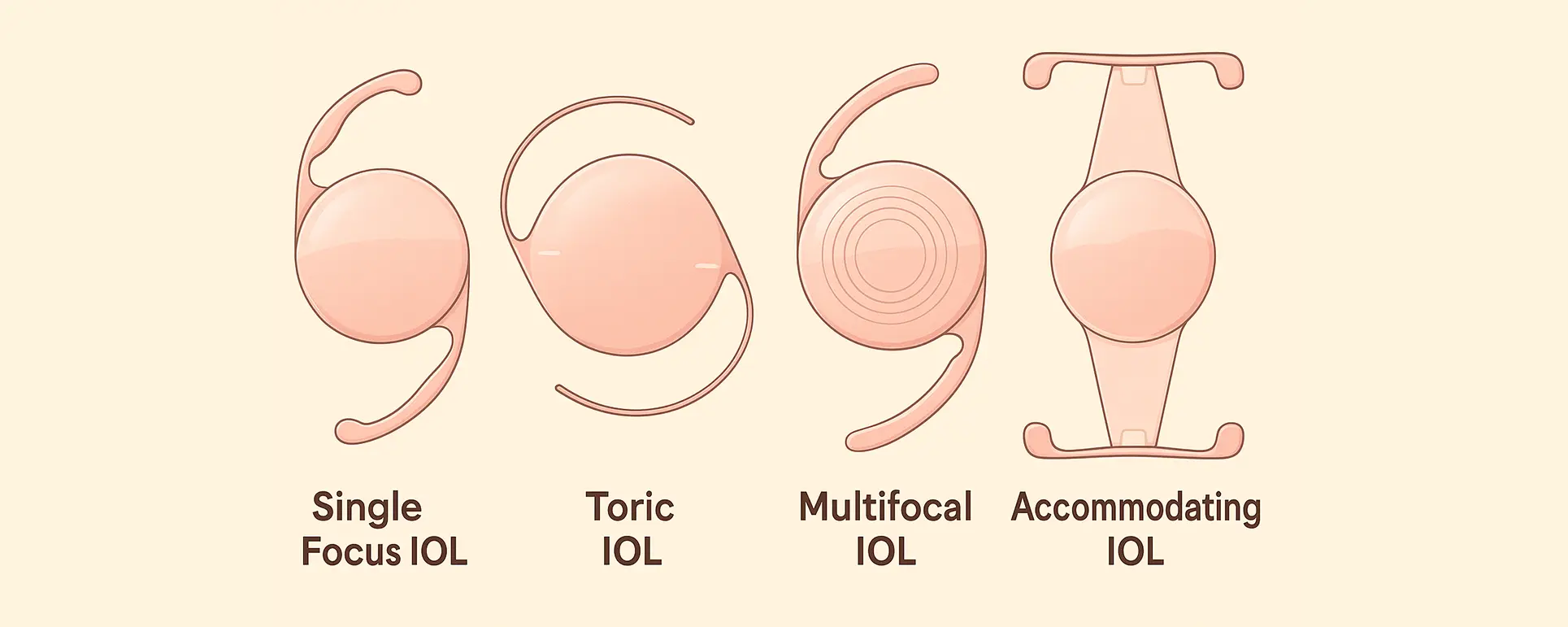
First, let’s clear up a common misconception. Many people think that cataract surgery is simply about restoring clear vision. While it certainly does that, the type of lens used can affect how you see at different distances, how you handle light, and whether you need glasses afterwards. Monofocal lenses are the standard choice. They are designed to focus at one distance, usually far away.
Multifocal lenses are more advanced. They allow you to focus at multiple distances, potentially reducing your dependence on glasses for reading, computer work, and other close tasks. Toric lenses are specifically designed for patients with astigmatism. They correct the uneven curvature of the cornea, offering clearer, sharper vision than standard lenses for people with this condition.
Each lens type has its benefits, but your lifestyle determines which is best for you. Let’s break this down in practical terms.
Step 1: Evaluate Your Daily Activities
The first step in choosing the right IOL is to think about what your typical day looks like. Ask yourself questions like:
- Do I spend most of my time outdoors or indoors?
- How often do I read or use screens?
- Am I an avid driver, especially at night?
- Do I enjoy hobbies that require precise near or intermediate vision, like knitting, painting, or photography?
Example: The Active Commuter
Imagine Jane, who drives to work daily and often works on spreadsheets at her desk. She values clear distance vision for driving and intermediate vision for her computer. For someone like Jane, an EDOF lens might be ideal because it provides excellent intermediate vision while maintaining sharp distance vision. She may still need reading glasses for detailed close work, but the lenses cover most of her daily activities.
Example: The Avid Reader
On the other hand, Paul enjoys reading novels every evening and knitting in his spare time. His priority is near vision. A multifocal lens or a monovision approach (where one eye is corrected for distance and the other for near tasks) might suit him best. These options reduce his reliance on reading glasses and allow him to enjoy his hobbies without interruption.
Step 2: Consider Your Night Vision Needs

Night vision is an important factor that’s often overlooked. Some lenses, particularly certain multifocal lenses, can cause halos or glare around lights at night. This can affect driving, especially on poorly lit roads.
If you drive frequently after dark or live in an area with limited street lighting, you might prioritise a lens that offers the clearest possible distance vision and minimal visual disturbances. In such cases, a monofocal lens or a specially designed EDOF lens may be more suitable than some multifocal lenses.
Tip: Discuss your night-time driving habits with your surgeon. They can advise which lens types minimise glare and halo effects while still meeting your other visual needs.
Step 3: Factor in Screen Time
We live in a digital world, and many of us spend hours in front of screens each day. Computers, tablets, and smartphones require good intermediate vision, usually around 50–70 cm from your eyes. Standard monofocal lenses often fall short here, as they are typically optimised for distance.
If screen work is a major part of your day, consider lenses designed for intermediate vision, like EDOF lenses or certain multifocal designs. These lenses reduce eye strain and make prolonged screen time more comfortable.
Real-Life Example: Samantha works from home as a graphic designer. She spends most of her day at her computer and occasionally reads documents or sketches by hand. After cataract surgery with an EDOF lens, she can work without constantly swapping between glasses for distance and near tasks. Her workflow is smoother, and her eyes feel less fatigued.
Step 4: Hobbies and Special Interests
Your hobbies play a big role in IOL selection. Let’s break it down:
- Reading and crafts: Multifocal lenses or monovision can help you see up close.
- Photography or birdwatching: Lenses optimised for distance vision may be preferable, with near glasses on hand for close-up camera settings.
- Sports like golf or tennis: Clear distance vision is crucial, so monofocal or toric lenses may be best.
- Travel: Multifocal or EDOF lenses reduce your dependence on multiple pairs of glasses, making travel easier and more enjoyable.
When I meet patients, I often encourage them to describe their hobbies in detail. This gives a clear picture of their visual demands, and allows me to recommend the lens that aligns with their lifestyle.
Step 5: Think About Glasses Dependence

Some patients are happy to keep a pair of reading glasses on hand, while others prefer maximum independence from spectacles. Multifocal lenses can significantly reduce the need for glasses for near and intermediate tasks, while monofocal lenses may still require reading glasses for close work.
Scenario: John enjoys golfing, driving, and occasional reading. He doesn’t mind using glasses for reading newspapers at home, so a monofocal lens optimised for distance vision works well. He maintains excellent vision for his outdoor activities and can rely on glasses only when needed for close tasks.
Your attitude toward glasses will guide your choice of IOL. Be honest with yourself: do you want total freedom, or is a little assistance acceptable?
Step 6: Consider Astigmatism
Astigmatism is a common condition where the cornea isn’t perfectly round, causing blurred or distorted vision. Standard monofocal and multifocal lenses may not fully correct this. Toric lenses are designed specifically to correct astigmatism, giving sharper, clearer vision without relying on glasses.
Practical Tip: If you have significant astigmatism and want the clearest possible distance vision, ask your surgeon about toric lenses. They can often be combined with multifocal or EDOF lenses for patients seeking a broader range of vision.
Step 7: Evaluate Your Tolerance for Visual Phenomena
Some advanced lenses, particularly multifocal lenses, may cause visual side effects such as:
- Halos around lights
- Glare, particularly at night
- Slightly reduced contrast sensitivity
These phenomena don’t affect everyone, but they can be noticeable, especially for night driving or working in dimly lit environments. If you are highly sensitive to glare or need pristine night vision, discuss this with your surgeon before choosing a multifocal lens.
Tip: Surgeons often use simulations or trial lenses to help patients experience what their vision might be like with different IOLs. Experiencing this firsthand can help you make a confident choice.
Step 8: Lifestyle Case Studies
Let’s walk through a few detailed examples to illustrate how lifestyle influences lens choice.
Case Study 1: Emma, the Travel Enthusiast
Emma loves international travel and sightseeing. She values clear vision for walking tours, reading maps, and photographing landscapes. She also wants minimal reliance on glasses, as she dislikes carrying multiple pairs.
- Recommendation: Multifocal or EDOF lenses, prioritising distance and intermediate vision. Reading glasses may still be needed for small text, but overall freedom is maximised.
Case Study 2: David, the Night Driver
David drives frequently at night for work. He also enjoys reading in his downtime. He is concerned about halos or glare from streetlights.
- Recommendation: A monofocal lens for distance vision in both eyes, potentially combined with reading glasses for near tasks. This minimises glare and ensures safety while driving.
Case Study 3: Priya, the Avid Screen User
Priya spends 8–10 hours a day on a computer and reads a lot for work. She wants to reduce eye strain and avoid constantly switching between glasses.
- Recommendation: EDOF lens or a multifocal lens prioritising intermediate and near vision, providing smooth transition between computer work and close tasks.
Case Study 4: Alan, the Outdoorsman
Alan enjoys golf, hiking, and birdwatching. He wants sharp distance vision for sports and outdoor exploration.
Recommendation: Monofocal or toric lens for distance vision, supplemented with reading glasses for near tasks. Night vision considerations are secondary but still addressed.
Step 9: Recovery and Adaptation
Remember, no lens choice is entirely perfect at first. Your brain often needs time to adapt to a new visual system, especially with multifocal lenses. Some patients notice minor issues during the first few weeks, such as slight glare or difficulty focusing. These usually improve as your brain adjusts.
Tip: Patience is key. Following your surgeon’s post-operative instructions and attending follow-up appointments ensures the best outcome.
Step 10: Consult a Specialist
Finally, always consult a qualified ophthalmologist or eye surgeon. They can:
- Measure your eyes precisely
- Assess corneal shape, astigmatism, and pupil size
- Discuss your lifestyle in detail
- Recommend the lens type most suitable for you
For patients in London considering surgery, the team at London Cataract Centre can provide expert guidance on IOL replacement surgery in London, helping you choose a lens that fits your daily life.
Final Thoughts:Choosing the Right IOL for Your Lifestyle
Choosing the right IOL is more than a medical decision — it’s a lifestyle choice. The lens you select can shape how you read, drive, work, travel, and enjoy your hobbies. By evaluating your daily activities, night-time vision needs, screen time, hobbies, and tolerance for visual phenomena, you can make a choice that truly enhances your quality of life. Whether you prioritise freedom from glasses, night-vision clarity, or a balanced range of vision, there is a lens designed to match your needs. Honest self-assessment, combined with a detailed discussion with your surgeon, ensures the best possible outcome.
Remember, cataract surgery is a journey toward clearer sight, and choosing the right IOL ensures your eyes can fully support the life you want to live. If you are looking for IOL replacement surgery in London, you can get in touch with us at the London Cataract Centre, and our specialist team will be happy to guide you through the best vision-correction options for your lifestyle.
Reference:
1. Romualdi, G., et al. (2025) ‘Clinical Outcomes and Optical Bench Analysis of a Novel Enhanced Monofocal IOL’, Life, 15(6), p. 984. Available at: https://www.mdpi.com/2075-1729/15/6/984
2. D’Oria, F., et al. (2021) ‘Retinal Optical Quality of Multifocal Refractive and Diffractive Intraocular Lenses’, Journal of Clinical Medicine, 10(8), pp. Available at: https://www.mdpi.com/2304-6732/8/12/559
3. Breyer, D.R.H., Kaymak, H., Ax, T. & Hagen, P.R. (2017) ‘Multifocal and Extended Depth of Focus Intraocular Lenses’, Asia-Pacific Journal of Ophthalmology, 6(5), pp. 339–349. PubMed. Available at: https://pubmed.ncbi.nlm.nih.gov/28780781/
4. Rampat, R., et al. (2021) ‘Multifocal and Extended Depth-of-Focus Intraocular Lenses: Practical and Technical Update’, [Journal], (2021). PubMed. Available at: https://pubmed.ncbi.nlm.nih.gov/32980397/ PubMed 5. Han, K.E. & Lee, J.E. (2023) ‘Comparative Visual Performance and Patient Satisfaction following Cataract Surgery: EDOF versus Diffractive Multifocal IOLs’, PMC Article. Available at: https://pmc.ncbi.nlm.nih.gov/articles/PMC10707164/